
The shoulder joint is a ball-and-socket joint that joins the upper arm’s (humerus) bone with the shoulder blade (scapula).
Call us for the Help!
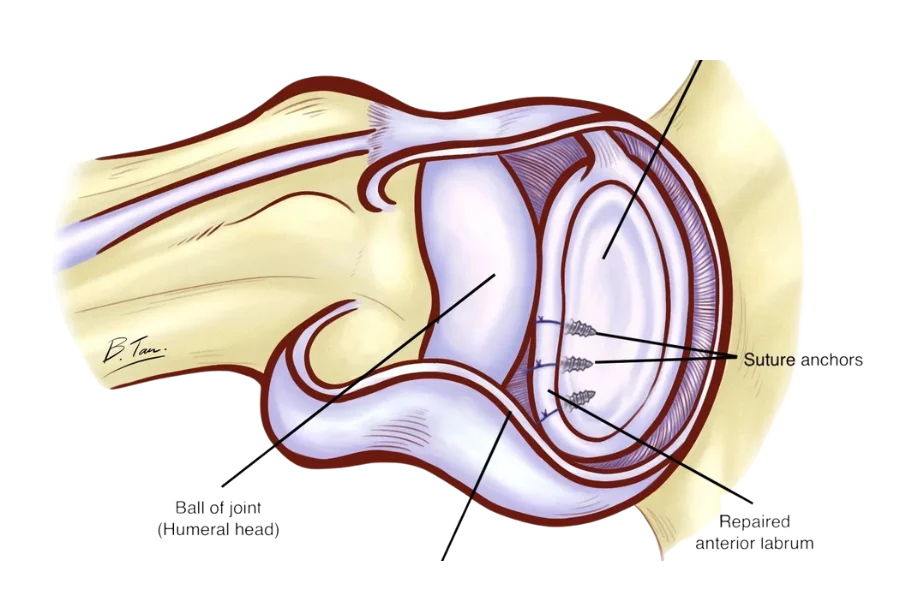
The glenoid cavity is the shallow socket of the scapula. A wide ligament that surrounds and stabilises the joint is known as the capsule. The glenoid labrum is a cartilage rim that attaches to the glenoid rim. When the arm is pushed out of its socket, the capsule and labrum rupture, usually from the glenoid cavity’s margin. When the humerus comes entirely out of the socket and stays out, it is called a dislocation. When the humerus comes partially out of the socket and then slips back in, this is known as a subluxation.
When the capsule breaks away from the glenoid rim, the shoulder becomes unstable and frequently dislocates or subluxes. The most common direction for the humeral head to dislocate is toward the front of the body (anteriorly); this typically occurs if the arm goes too far behind the body when the arm is \sin an overhead position (such as when throwing a ball). While power is exerted toward the back of the shoulder, the humeral head can dislocate toward the back of the body (posteriorly); this can happen when falling forward on an outstretched arm, convulsions, electrical shocks, or blocking with the arm straight ahead in football.
It’s possible for the shoulder to be insecure in more than one direction. Individuals with loose joints (double jointed) are more prone to multidirectional instability.
To help confirm the diagnosis of instability several different tests are helpful and may be employed:
Some people who dislocate their shoulder recover quickly and may not experience repeated instability. They are usually elderly and do not participate in sports. Recurrent dislocations and subluxations are common in young people, especially sports, who require surgery to repair the problem.
By reattaching the ruptured capsule to the glenoid rim, the unstable shoulder join can be restored.
This is known as a Bankart repair. The procedure is usually performed using arthroscopic surgery, which is a minimally invasive procedure. If the capsule or labrum is found to have broken away from the bone during surgery, perforations are created in the glenoid rim.
Stitches are threaded through each hole, through the capsule, and through the labrum, then knotted to secure the capsule to the glenoid rim. The capsule heals back to the bony rim, preventing the shoulder from dislocating again. The capsule takes several months to repair and return to the bone. During this time, extremes of shoulder motion should be avoided so that the stitches are not torn. Arthroscopic Bankart repair has a success rate of nearly 97%.
Our Treatment Process
Introduction & Connection
Assessment & Treatment Planning
Treatment & Recovery
Review & Ongoing Support
Why Choose Us?
Are you having ortho problems? Contact us today!
Contact With Us
Call us: +91 90032 22747